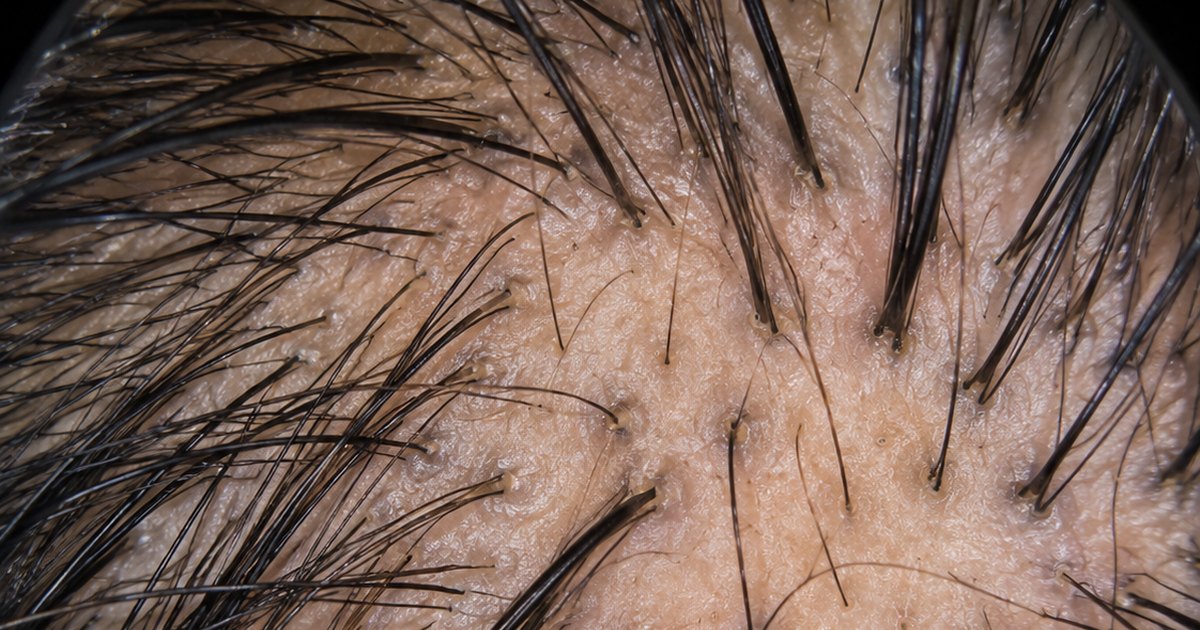
Trichoscopy: the magnified scalp view that shows what the eye cannot
Hair loss responds best when the cause is identified before treatment begins. Pattern hair loss, shedding after an illness or childbirth, scalp conditions and styling tension all look like “hair fall” in the mirror but need entirely different plans. At Auraa every case starts with a structured assessment — history, scalp examination, trichoscopy and blood work where indicated — and the plan is then layered from medical treatment, PRP, GFC, exosome therapy and scalp care as the diagnosis requires. Reduced shedding is usually noticed first; density is measured against baseline photographs at three and six months.
Hair fall and hair loss are not the same thing
Everybody sheds hair. Around 85 to 90 per cent of the hairs on a scalp are actively growing at any moment, and the rest are resting before they let go — which works out at roughly 100 hairs a day for most people.¹ Hairs you find on the pillow or in the shower are, in that range, simply the system working.
What matters clinically is not the hairs leaving but whether they are being replaced, and at what thickness. Shedding is a temporary rise in how many hairs let go at once, and it recovers. Thinning is a gradual change in the calibre of the hairs that grow back, and it is the one that needs a long view.
Those two situations need completely different plans, and telling them apart is the first thing we do.
The patterns we see most often
| Pattern hair loss | Telogen effluvium | Scalp-related | Traction | |
|---|---|---|---|---|
| What you notice | Parting widening, gradual thinning on the crown | Sudden, heavy shedding all over | Itching, flaking, tenderness alongside fall | Thinning at the hairline and temples |
| Timing | Slow, over years | Starts two to four months after a trigger¹ | Follows the scalp condition | Follows years of tight styling |
| Usual drivers | Genetic and hormonal sensitivity | Illness, fever, surgery, childbirth, weight loss, nutritional deficiency, thyroid change | Dandruff, seborrhoeic dermatitis, folliculitis | Tight braids, buns, extensions |
| Outlook | Very manageable with a sustained plan | Recovers, usually within six to nine months¹ | Settles once the scalp is treated | Improves markedly once tension is removed |
More than one of these frequently runs at the same time — a shedding episode sitting on top of slow pattern thinning is one of the most common presentations we see, and it is also the one most likely to be misread as a sudden catastrophe when it is actually two separate, treatable things.
How we assess your hair
Your first visit is an assessment, not a sales conversation. It is also the visit that saves you from paying for the wrong treatment.
History. When it started, what was happening in your life three to four months before that, your family pattern, diet, medications, and for women the hormonal picture including pregnancy and thyroid.
Scalp and hair examination. Where the thinning sits, whether the parting has widened, the condition of the scalp itself, and a pull test.
Trichoscopy. Magnified examination of the scalp, which shows what the eye cannot — whether hair calibre is becoming uneven, how many hairs are emerging from each follicular unit, and whether the follicles are open and healthy.
Blood work where indicated. Iron studies, thyroid function, vitamin D and B12 are the common ones. Dr. Fatima will advise which apply to you, and they are reviewed with your own doctor where the results need medical management.
Standardised photography, so progress at three and six months is measured rather than remembered. Hair grows slowly; photographs are far more honest than impressions.
Treatment options at Auraa
Hair plans are layered. No single injection, serum or tablet does the whole job, and the combinations do better than any part alone.
Medical treatment
Where the assessment points to pattern hair loss, medical treatment is the backbone of the plan and everything else works alongside it. Topical minoxidil is the most widely established option and is prescribed in different strengths and formulations depending on the person.
PRP — platelet-rich plasma
Your own blood is drawn, spun to concentrate the platelets and the growth factors they carry, and that concentrate is delivered into the scalp. It is the most studied of the three regenerative options we offer.
A systematic review and meta-analysis of nine randomised controlled trials covering 238 patients found that PRP increased hair density at both three and six months compared with placebo, and reported no serious adverse reactions.² The same analysis is clear that hair count and hair diameter did not separate significantly from placebo — so density is the outcome the evidence supports, and density is what we set as the expectation.²
Because the material comes from your own blood, PRP sits comfortably alongside medical treatment rather than competing with it.
GFC — growth factor concentrate
A more refined preparation, again from your own blood, processed to yield a higher and more consistent concentration of growth factors. In a single-centre study of patients with pattern hair loss given three injections three to four weeks apart, hair density and hair growth ratio improved significantly by three months, with the improvement sustained at six months and rated positively by both patients and independent assessors.³
That study was retrospective and single-arm, so the evidence base behind GFC is younger and smaller than PRP's. We say so plainly, and we use it where the scalp picture and the person's preference make it the better fit.
Exosome therapy
The newest of the three. Exosome preparations carry signalling material intended to influence the pathways involved in hair follicle cycling, and the early clinical work is encouraging. It is also the smallest evidence base of the three — a 2025 systematic review identified eleven published clinical investigations, of which two were randomised controlled trials.⁴
We offer it selectively, for patients whose assessment suggests it is the right fit, and always with an honest account of where the science currently stands. It is an advanced option, not a replacement for the fundamentals.
Scalp treatment
Dandruff, seborrhoeic dermatitis and folliculitis drive a great deal of hair fall, and they are among the most satisfying things to treat because they respond quickly. Where the scalp is inflamed, settling it often reduces shedding on its own — and it makes every other treatment work better. We treat the scalp before and alongside the regenerative work, never after it.
Nutrition and the everyday factors
Iron, protein, vitamin D and overall nutritional status all influence hair, and correcting a documented deficiency is one of the most reliable interventions there is. We also look at styling tension, heat, chemical processing and sleep — small, free changes that quietly protect the result you are paying for.
Telogen effluvium: the one that recovers on its own
If your hair started shedding heavily and you can trace it back to something that happened two to four months earlier — a fever, an illness, surgery, childbirth, a crash diet, a period of real stress — this is very likely what you have, and the outlook is genuinely good.
In this situation more hairs than usual move into the resting phase at once and let go together a few months later. Each one that leaves is replaced by a new growing hair, so there is no danger of complete baldness, and fullness returns as the new hairs come through.¹ It rarely lasts longer than six months, and most cases run their course within six to nine.¹
What we do here is confirm the diagnosis, identify and correct anything still contributing — a nutritional deficiency, a thyroid change, a medication worth reviewing with your doctor — look after the scalp, and photograph the baseline so you can see the recovery happening rather than worry about it. That reassurance, backed by measurement, is often the most valuable part of the visit.
What a course looks like
Regenerative sessions are usually given as a course of four to six, spaced about four weeks apart, followed by maintenance. The exact number is confirmed after your assessment, never quoted before it.
Hair moves slowly. Reduced shedding is commonly the first thing people notice. Visible density change is assessed at three months and again at six, against your baseline photographs.
Consistency is the active ingredient. Pattern hair loss responds to sustained care rather than bursts of it, which is why the home part of the plan is kept short enough to actually follow.
You receive a written plan with clear costs after your assessment, and no pressure-selling at any point.
When a hair transplant is the right conversation
A transplant is a good operation in the right person at the right time — and the right time is usually after the medical plan has stabilised the hair that is still there. Transplanting into an area that is still actively thinning means watching the surrounding hair continue to change around the grafts.
We are not a transplant centre, which means we have no reason to steer you towards one. If your assessment suggests a transplant would serve you, we will say so, and tell you what to get stabilised first so the procedure gives you its best result.
Keeping your result
Stay with the medical plan once it is working — this is the part that holds everything else.
Maintenance sessions at the interval set for you, rather than waiting for a visible change before returning.
Keep the scalp healthy. Treat flaking and itching early, while it is a small job.
Review photographs periodically, so the plan is adjusted on evidence.
Read more on hair
- PRP vs GFC vs Exosomes for Hair Loss: A Doctor's Honest Comparison
- Sudden Hair Fall After Illness, Fever or Childbirth: What It Usually Is
- 4 Things to Check Before Getting a Hair Transplant
Book a consultation
Auraa Skincare Clinic & Institute
3rd Floor, Door 302, Falcon Valley Rd, beside Narayanamma Engineering College, opp. DMart, Ambedkar Nagar, Film Nagar, Hyderabad, Telangana 500008
Coming from the Toli Chowki side, continue through towards Shaikpet and Film Nagar — we are on Falcon Valley Road, directly opposite DMart.
Mon–Sat 10:30 AM – 8:00 PM · Sunday by appointment
Consultations in English, Hindi, Urdu and Telugu
Frequently asked questions
How do I know if my hair fall is normal?
Losing around 100 hairs a day is normal for most people. What matters is whether those hairs are being replaced and at what thickness. A widening parting, a thinner ponytail or hairs growing back finer than before are the signals worth assessing — and a magnified scalp examination answers the question in one visit.
Which is better, PRP or GFC?
PRP has the larger evidence base: a meta-analysis of nine randomised trials found increased hair density at three and six months compared with placebo, with no serious adverse reactions. GFC is a more concentrated preparation with promising but younger evidence — a single-centre study found significant improvement in hair density by three months, sustained at six. Which suits you depends on your scalp picture and your preference, and is decided at your assessment.
My hair started falling heavily after an illness. Will it grow back?
Very likely yes. Shedding that begins two to four months after a fever, illness, surgery, childbirth or sudden weight loss is usually telogen effluvium. Every hair that leaves is replaced by a new growing hair, so there is no danger of complete baldness, and most cases run their course within six to nine months. We confirm the diagnosis, correct anything still contributing, and photograph a baseline so you can see the recovery.
How many PRP or GFC sessions will I need?
Usually a course of four to six sessions about four weeks apart, followed by maintenance. The number is confirmed after your assessment rather than quoted before it, because it depends on the cause of your hair loss, how long it has been present and what else the plan includes.
Do I need blood tests before hair treatment?
Often yes. Iron studies, thyroid function, vitamin D and B12 are the common ones, because correcting a documented deficiency is one of the most reliable things that can be done for hair. Dr. Fatima will advise which apply to you, and results needing medical management are reviewed with your own doctor.
How much does hair loss treatment cost in Hyderabad?
It depends on the cause and the plan built around it, which is why we do not publish a single price. After your assessment you receive a written plan with clear costs for the full course, so you know the total before you begin.
References
- Telogen Effluvium. Harvard Health Publishing, Harvard Medical School, reviewed October 2024. https://www.health.harvard.edu/a-to-z/telogen-effluvium-a-to-z
- Platelet-Rich Plasma for Androgenetic Alopecia: A Systematic Review and Meta-Analysis of Randomized Controlled Trials. Journal of Cutaneous Medicine and Surgery. 2023;27(5):504–508. https://pubmed.ncbi.nlm.nih.gov/37533146/
- Evaluation of the safety and efficacy of concentrated growth factors for hair growth promotion in androgenetic alopecia patients: A retrospective single-centre, single-arm study. Journal of Cosmetic Dermatology. doi:10.1111/jocd.16519. https://www.ncbi.nlm.nih.gov/pmc/articles/PMC11626311/
- Exosome Therapy for Hair Loss: Research, Risks and Regulatory Status. American Hair Loss Association, updated October 2026. https://www.americanhairloss.org/hair-loss-treatment/regenerative-medicine/exosomes/
Every source above was opened and checked against the claim it supports before publication.
Medically reviewed by Dr. Fatima Sajeeda — Integrative Medicine Practitioner, Expert in Medical Aesthetics, Cosmetologist & Trichologist · 16+ years · International Faculty, IEB UK · Auraa Skincare Clinic, Film Nagar, Hyderabad
Book a Hair & Scalp Assessment on WhatsApp← Back to site