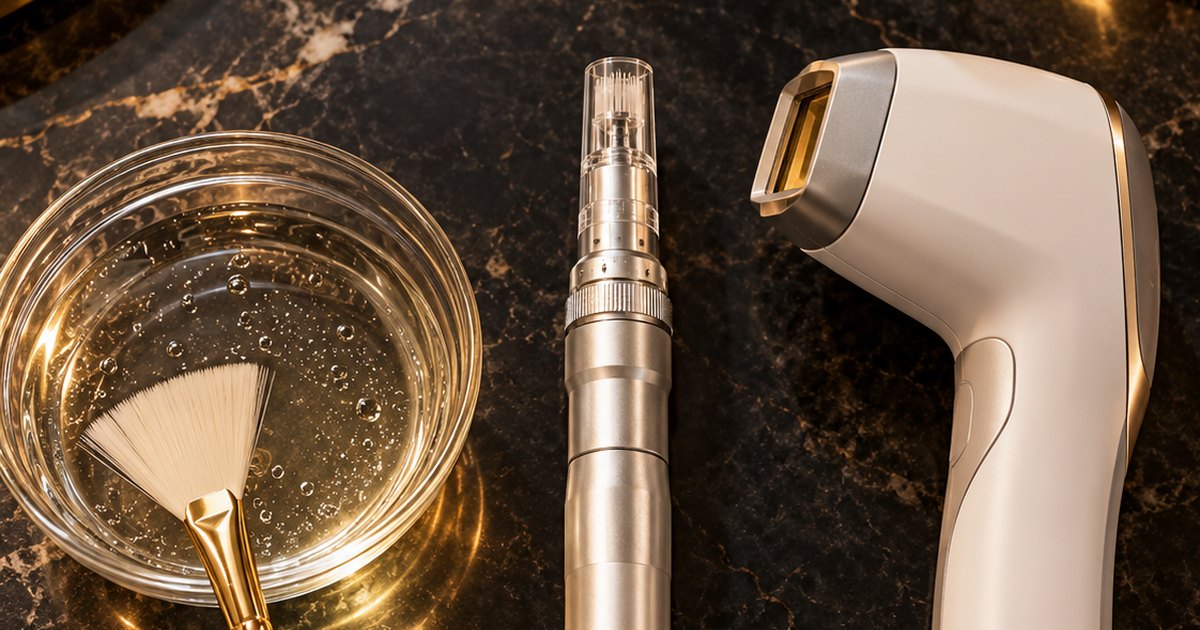
Device selection is matched to your skin and hair type, not the other way round
Laser hair removal works well on Indian skin when the settings are built for it. At Auraa we use an 810nm diode laser in low-fluence, high-repetition mode with a cooled tip, alongside Advanced IPL and electrolysis, so the method is matched to your hair and skin type rather than to one machine. In an Indian study of 71 women with Fitzpatrick skin types IV to VI treated this way, patients underwent an average of 5.2 sessions, 84.5 per cent were rated as achieving 75 to 100 per cent improvement, 95.8 per cent reported low to no discomfort, and no burns or pigment changes were reported in any patient. Every course here begins with a test patch.
Why Indian skin needs a laser chosen for it
Laser hair removal works by selective photothermolysis: light is absorbed by the melanin in the hair, converted to heat, and that heat disables the follicle's ability to regrow the hair.
The useful thing to understand is that melanin sits in the skin as well as the hair. In Fitzpatrick types IV to VI — where most Indian skin falls — there is more of it in the epidermis, so the wavelength, the energy and the cooling all have to be chosen with that in mind rather than borrowed from settings designed for lighter skin.
This is why the question that matters is not “which machine does this clinic own” but “who is setting it, and on what basis”. The same device in two pairs of hands gives two different experiences.
Diode, IPL and electrolysis — what we use, and when
We hold three distinct technologies so that the method can be matched to your hair and skin, rather than your hair and skin matched to one machine.
| 810nm diode laser | Advanced IPL | Electrolysis | |
|---|---|---|---|
| Best suited to | Dark, coarse to medium hair on Fitzpatrick IV–VI | Selected skin and hair types, and larger surface areas | Fine, light, grey or isolated hairs |
| How it works | Single wavelength absorbed by hair melanin, delivered with a cooled tip | Broad-spectrum filtered light | Current delivered to one follicle at a time |
| Typical use | Face, underarms, bikini, arms, legs, back, chest | Larger body areas, selected cases | Upper lip strays, chin, brow shaping, finishing after laser |
| Pace | Course of sessions, area by area | Course of sessions | Hair by hair — precise rather than fast |
Electrolysis matters more than most clinics admit. Laser needs pigment in the hair to work, so fine, light or grey hairs are not what it is designed for — and they are exactly the hairs electrolysis handles. Holding both means a complete answer rather than a partial one.
What the evidence shows for Indian skin
This is worth knowing in some detail, because it is reassuring and it is specific to skin like yours.
An Indian study published in the Journal of Clinical and Aesthetic Dermatology treated 71 women with Fitzpatrick skin types IV to VI using an 810nm diode laser in low-fluence, high-repetition “in motion” mode — the technique in which energy is accumulated gradually in small doses over a mapped area with a cooled tip in constant movement, rather than delivered in single high-energy shots.¹
Patients underwent an average of 5.2 treatments. On the standard assessment scale, 84.5 per cent were rated as achieving 75 to 100 per cent improvement by the treating physician, and 81.7 per cent rated themselves in the same band.¹
On comfort and safety: 95.8 per cent of patients reported low to no discomfort throughout their sessions, and no burns, hyperpigmentation or hypopigmentation were reported in any patient.¹ The authors describe this as a first-of-its-kind Indian study in a large group demonstrating a high degree of safety and efficacy in these skin types.¹
The mechanism behind that comfort is simple: by keeping each pass below the threshold that causes trouble and letting the heat build gradually in the follicle while the cooled tip protects the surface, the treatment reaches the target without stressing the skin above it.¹
This — low fluence, high repetition, constant motion, cooled tip — is how we run diode hair reduction at Auraa.
Why it takes a course rather than one session
Hair grows in cycles, and this single fact explains the entire treatment schedule.
At any moment only a proportion of the hairs in an area are in the active growing phase. Hairs in the resting phase have no meaningful connection to the follicle's growth machinery at that moment, so light directed at them has nothing useful to act on. They have to be caught on a later pass, once they re-enter the growing phase.²
That is why sessions are spaced weeks apart rather than days, and why a course is needed. Each session catches the portion of hair that happens to be growing at that time. Six sessions do not mean the first five failed — it means six different cohorts of hair were treated.
It is also why the interval is set per area rather than globally: facial hair cycles faster than hair on the legs or back, so facial sessions are scheduled more closely together.
PCOS and hormone-related hair
If your facial or body hair is driven by polycystic ovary syndrome, laser is the right treatment and the international guidance says so clearly — but the best results come from treating both sides of the problem.
The 2023 International Evidence-Based Guideline for PCOS recommends that laser and light therapies should be considered for reducing facial hirsutism, and for the associated effects on mood, anxiety and quality of life.³ It also notes that women with PCOS may need a greater number of sessions than women with hirsutism from other causes — useful to know at the start so the plan is realistic.³
The guideline's practice point is the one worth acting on: adding appropriate hormonal management, prescribed by your own doctor or gynaecologist, to laser treatment may provide greater hair reduction and better maintenance than laser alone.³ Treating the follicle and the hormonal driver together is simply more effective than treating either on its own.
The guideline also records that low and high fluence appear to have similar efficacy for facial hair, while low fluence is associated with less pain — which supports the low-fluence approach we use.³ And because laser needs pigment to work, blond, grey and white hairs are addressed with electrolysis instead.³
What happens at your first session
Assessment. Skin type, hair colour and thickness, the areas you want treated, your medical history, and anything — medications, recent sun exposure, recent waxing — that affects timing.
A test patch, placed discreetly, before any full area is treated. Settings are then confirmed from how your skin actually responded rather than from an assumption.
Shaving, not waxing or threading, before treatment. The laser needs the hair root in place to work on. We will tell you exactly when to stop waxing or threading before you start — usually about four weeks.
Protective eyewear for you and the operator, every session, without exception.
The session itself. Gel is applied, the area is mapped into sections, and the handpiece moves steadily across each one with its cooled tip in contact. Most people describe a sensation of warmth. Small areas take minutes; full legs or a back take longer.
Areas we treat
Face: upper lip, chin, jawline, sides of the face, between the brows.
Body: underarms, arms, bikini line, legs, abdomen, chest, back and shoulders.
Sessions can be combined so several areas are treated in one visit, which is usually how a full-body plan is scheduled.
Before and after each session
Before. Shave the area the day before or the morning of your appointment. No waxing, threading or plucking for four weeks beforehand. Avoid deliberate sun exposure and tanning in the days before. Come with clean skin, free of deodorant, lotion or make-up on the area.
After. Mild warmth and slight pinkness for a few hours is the normal response. Apply a cool compress and a simple moisturiser. Use daily sun protection on treated areas, keep to lukewarm showers for the first day, and skip the gym, sauna and swimming pool for 24 hours. Some hairs appear to grow out over the following one to three weeks before shedding — that is the treated hair leaving, not new growth.
Maintenance
After the main course, most people need occasional top-up sessions — typically once or twice a year, and more often for facial areas or where a hormonal factor is involved.
This is normal and it is planned for from the start, not sprung on you at the end. Your maintenance interval is set after your course based on what your hair actually does.
Read more on laser hair removal
- Is Laser Hair Removal Safe for Indian Skin?
- How Many Laser Hair Removal Sessions Will I Need?
- Facial Hair and PCOS: What Laser Can Do, and What Works Alongside It
Book a consultation
Auraa Skincare Clinic & Institute
3rd Floor, Door 302, Falcon Valley Rd, beside Narayanamma Engineering College, opp. DMart, Ambedkar Nagar, Film Nagar, Hyderabad, Telangana 500008
Coming from the Toli Chowki side, continue through towards Shaikpet and Film Nagar — we are on Falcon Valley Road, directly opposite DMart.
Mon–Sat 10:30 AM – 8:00 PM · Sunday by appointment
Consultations in English, Hindi, Urdu and Telugu
Frequently asked questions
Is laser hair removal safe for Indian skin?
Yes, when the wavelength, energy and cooling are chosen for melanin-rich skin. An Indian study of 71 women with Fitzpatrick skin types IV to VI treated with a low-fluence, high-repetition 810nm diode laser reported no burns, hyperpigmentation or hypopigmentation in any patient, and 95.8 per cent reported low to no discomfort. That low-fluence, cooled-tip, in-motion approach is how we run diode hair reduction here, and every course starts with a test patch.
How many sessions will I need?
In the Indian study of skin types IV to VI, patients underwent an average of 5.2 sessions, with 84.5 per cent rated as achieving 75 to 100 per cent improvement. Your own number depends on the area, your hair thickness and any hormonal factor, and is confirmed after your assessment. A course is needed because only a proportion of hairs are in the active growing phase at any one time, and only those can be treated in a given session.
Does laser hair removal hurt?
Most people describe a sensation of warmth rather than pain. In the Indian study cited on this page, 95.8 per cent of patients reported low to no discomfort across their sessions. The in-motion technique with a cooled tip, which spreads the energy gradually rather than delivering it in single high-energy shots, is the reason comfort is good in this approach.
Can I have laser hair removal if I have PCOS?
Yes. The 2023 International Evidence-Based Guideline for PCOS recommends laser and light therapies for reducing facial hirsutism in women with PCOS. The guideline notes a greater number of sessions may be needed than for other causes, and that adding hormonal management prescribed by your own doctor may give greater hair reduction and better maintenance than laser alone.
Can I shave or wax between sessions?
Shaving between sessions is fine and expected. Waxing, threading and plucking are not, because they remove the root that the laser needs to target. Stop those about four weeks before you begin and use shaving throughout the course instead.
Does it work on white, grey or very fine hair?
Laser needs pigment in the hair to work, so blond, grey and white hairs are not what it is designed for. This is exactly where electrolysis comes in — it treats the follicle directly regardless of hair colour. We hold both, so fine and light hairs are addressed rather than left out of the plan.
How much does laser hair removal cost in Hyderabad?
It depends on which areas you are treating and how many sessions your assessment indicates, which is why we do not publish a single price. After your consultation you receive a written plan with clear costs for the full course, including any combined-area pricing.
References
- Agarwal M, Velaskar S, Gold MH. Efficacy of a Low Fluence, High Repetition Rate 810nm Diode Laser for Permanent Hair Reduction in Indian Patients with Skin Types IV–VI. Journal of Clinical and Aesthetic Dermatology. 2016;9(11):29–33. https://jcadonline.com/efficacy-of-a-low-fluence-high-repetition-rate-810nm-diode-laser-for-permanent-hair-reduction-in-indian-patients-with-skin-types-iv-vi/
- Telogen Effluvium (hair growth cycle — anagen and telogen phases). Harvard Health Publishing, Harvard Medical School, reviewed October 2024. https://www.health.harvard.edu/a-to-z/telogen-effluvium-a-to-z
- International Evidence-Based Guideline for the Assessment and Management of Polycystic Ovary Syndrome 2023, Section 4.8: Mechanical laser and light therapies for hair reduction. Monash University. https://www.monash.edu/__data/assets/pdf_file/0003/3371133/PCOS-Guideline-Summary-2023.pdf
Every source above was opened and checked against the claim it supports before publication.
Medically reviewed by Dr. Fatima Sajeeda — Integrative Medicine Practitioner, Expert in Medical Aesthetics, Cosmetologist & Trichologist · 16+ years · International Faculty, IEB UK · Auraa Skincare Clinic, Film Nagar, Hyderabad
Book a Laser Hair Removal Consultation on WhatsApp← Back to site