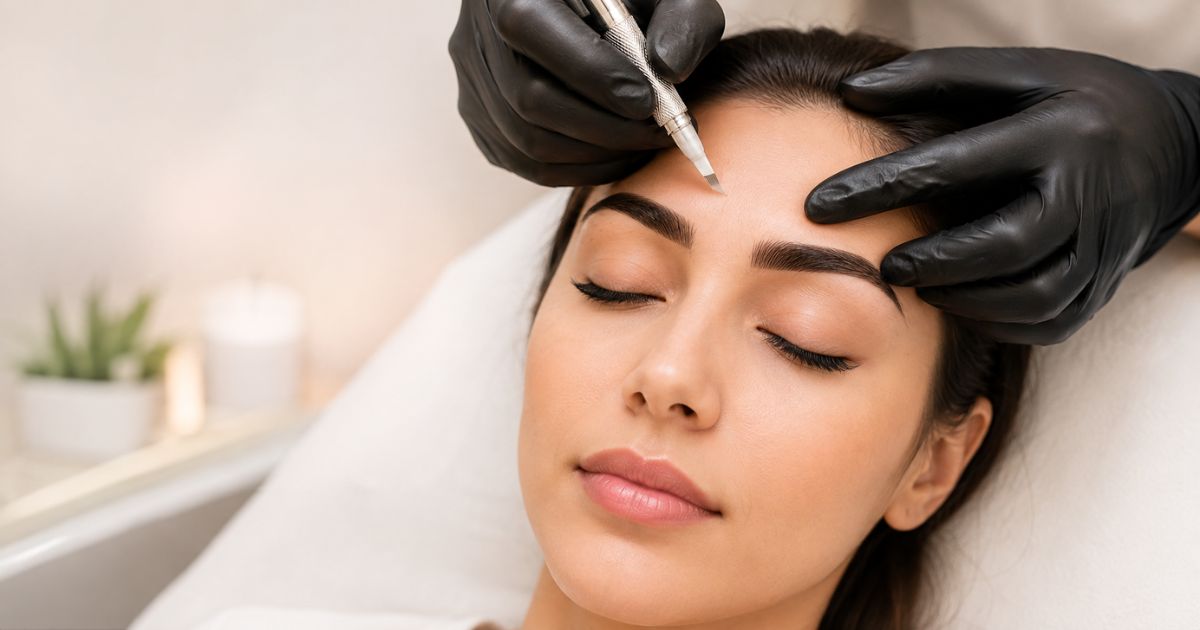
Shape is decided with you, in the mirror, before any pigment is placed
Semi-permanent makeup places pigment into the upper layers of the skin to define brows and lips. At Auraa we offer microblading, ombré powder brows, combination brows, lip blush and clinical camouflage for scars and vitiligo. Which technique suits you depends on your skin type — strokes soften faster on oily skin, where shading holds better. Every appointment begins with mapping agreed in the mirror, pigment selected for your skin undertone, single-use sterile tools and a patch test. The retouch at four to six weeks is part of the treatment and is included in the price.
The four techniques, and who each suits
These are different methods, not different brand names for the same thing. Choosing the right one for your skin is most of the result.
| Microblading | Ombré powder brows | Combination brows | Lip blush | |
|---|---|---|---|---|
| How it looks | Fine individual hair strokes | Soft shaded gradient, light to defined | Strokes at the front, shading behind | Soft natural lip colour |
| Best suited to | Normal to dry skin, sparse brows | Oily skin, larger pores, fuller styles | Mixed skin, wanting both texture and density | Pale, uneven or undefined lips |
| Finish | Most natural, closest to real hair | Polished, like softly filled brows | Natural at the front, defined at the tail | Like a healed tint, not lipstick |
| Typical longevity | 12–18 months | 18–24 months | 18–24 months | 12–24 months |
If you have oily skin and have been told microblading is the only option, that is worth a second conversation. Strokes soften faster on oilier skin; ombré and combination brows hold their definition better.
Mapping comes before pigment
This is the part that decides whether you love the result, and it happens before a single stroke is made.
We measure your face and map the brow to your own proportions — where it should begin, where the arch should sit, where it should end, and how your two sides differ, because almost everyone’s do. The shape is drawn on and shown to you in a mirror.
Nothing starts until you are happy with it. If you want it thicker, thinner, higher, softer or more defined, this is the moment to say so — and saying so is expected, not awkward.
The same principle applies to lips: shape and colour are agreed with you, in the mirror, before any pigment is placed.
Pigment chosen for Indian skin tones
Pigments heal differently on different undertones. This is the most common reason semi-permanent work done cheaply ends up looking grey, ashy or orange some months later — the pigment was chosen for a different skin tone than the one it was placed in.
Your pigment is selected to suit your natural brow colour, your hair colour and your skin undertone, so that the healed result reads warm and natural rather than flat. We are planning for how it looks in a year, not how it looks on day one.
Hygiene, in plain terms
Semi-permanent makeup breaks the skin barrier. That makes sterile technique the whole of the safety conversation, and you are entitled to see it.
Single-use blades and needles, opened in front of you.
Single-use pigment pots, never decanted from a shared container.
Gloves, a station set up fresh, and correct disposal into a sharps container.
A patch test before your appointment. Allergic reactions to pigments are uncommon, but delayed inflammatory and granulomatous reactions to cosmetic micropigmentation are documented in the medical literature, sometimes appearing months after a procedure.¹ A patch test is a small, sensible step and we do it as standard.
This is performed inside a medical clinic, by trained practitioners, under Dr. Fatima’s supervision — not in a salon back room.
Clinical camouflage — the one most people do not know about
The same micropigmentation skill applied to a medical problem rather than a cosmetic one.
Pigment is matched to your surrounding skin and placed to even out the appearance of:
- Scars that have healed pale and remain visible
- Stable vitiligo patches, where medical treatment has reached its limit
- Stretch marks that stay silvery after texture treatment
This is not a replacement for medical treatment and we will not present it as one — it is what you consider when the medical options have done what they can and an appearance gap remains. Suitability depends on the area, the stability of the condition and your skin, and is assessed at consultation.
Healing, week by week
Predictable, and knowing it in advance removes nearly all the anxiety.
Days 1 to 3. Noticeably darker and bolder than the final result. Almost everyone has a moment of doubt here. Almost everyone is fine.
Days 3 to 7. Light flaking. Do not pick, scratch or rub — picking lifts pigment out and causes patchy healing.
Days 7 to 14. The work looks faint, sometimes alarmingly so. The pigment has not gone; new skin has formed over it and it will resurface.
Weeks 3 to 4. True colour emerges, softer and more natural than day one.
Weeks 4 to 6. The retouch.
The retouch is part of the treatment
Not an upsell, and not a correction of a mistake.
Skin takes pigment unevenly on a first pass. The retouch balances anything that healed lighter, refines the shape now that it has settled, and adjusts colour if needed. The result after a retouch is meaningfully better than after one session — which is why it is built into the plan and the price from the start.
A quoted price that excludes the retouch is not a complete price.
Aftercare
Keep the area dry for 7 to 10 days — no swimming, sauna or steam, and short showers kept off the face.
Do not pick or scratch. The single most important instruction.
No make-up on the treated area until healed.
Avoid direct sun, and use sun protection afterwards — sun is the main cause of premature fading.
Apply the aftercare balm sparingly, exactly as instructed.
Who should wait
Tell us at consultation if you are pregnant or breastfeeding, have active acne, eczema or psoriasis in the area, a history of keloid scarring, are taking medication that affects skin healing, or have had recent peels or laser nearby. Also tell us about previous work done elsewhere, including faded work — old pigment affects what is achievable and sometimes needs addressing first.
None of these is necessarily a no. They change the timing or the approach, and it is better to know beforehand.
Read more
- Eyebrow Microblading: What to Expect Before, During and After
- HydraFacial & Medical Facials in Hyderabad
- Acne Scar Treatment in Hyderabad
Book a consultation
Auraa Skincare Clinic & Institute
3rd Floor, Door 302, Falcon Valley Rd, beside Narayanamma Engineering College, opp. DMart, Ambedkar Nagar, Film Nagar, Hyderabad, Telangana 500008
Coming from the Toli Chowki side, continue through towards Shaikpet and Film Nagar — we are on Falcon Valley Road, directly opposite DMart.
Mon–Sat 10:30 AM – 8:00 PM · Sunday by appointment
Consultations in English, Hindi, Urdu and Telugu
Frequently asked questions
What is the difference between microblading and ombre powder brows?
Microblading creates fine individual hair strokes and gives the most natural finish, suiting normal to dry skin. Ombre powder brows create a soft shaded gradient and hold their definition better on oily skin and larger pores. Combination brows use strokes at the front and shading behind. Which suits you is decided at consultation, not before.
How long does semi-permanent makeup last?
Roughly 12 to 18 months for microblading and 18 to 24 months for ombre and combination brows, with lip blush typically 12 to 24 months. It lasts longer on drier skin with good sun protection and fades faster with sun exposure or regular use of strong actives near the area.
Is the retouch included?
Yes, it is built into the plan and the price. The four-to-six-week retouch is part of how the technique works rather than a correction — skin takes pigment unevenly on a first pass, so the retouch balances, refines and adjusts colour. A quoted price that excludes the retouch is not a complete price.
Why do my brows look faint after two weeks?
New skin forms over the pigment during healing, which makes the work look faint around days 7 to 14. The pigment has not gone and it will resurface. The true colour emerges at weeks three to four, softer and more natural than day one.
Is it safe?
It breaks the skin barrier, so sterile single-use blades, needles and pigment pots are the whole safety conversation — and you are entitled to see packaging opened in front of you. Delayed inflammatory and granulomatous reactions to cosmetic micropigmentation are documented though uncommon, which is why we patch test as standard. The work is done inside a medical clinic under Dr. Fatima's supervision.
Can semi-permanent makeup cover scars or vitiligo?
Clinical camouflage uses the same micropigmentation skill to even out the appearance of healed pale scars, stable vitiligo patches and silvery stretch marks. It is not a replacement for medical treatment — it is what you consider once medical options have done what they can. Suitability depends on the area and the stability of the condition.
Why did my previous brows heal grey or orange?
Usually because the pigment was chosen for a different skin undertone. Pigments heal differently on different undertones, so the selection has to be made for how it will look in a year, not on day one. Old pigment also affects what is achievable now, so tell us about any previous work even if it has faded.
References
- Chronic granulomatous and sarcoid-type reactions to eyebrow micropigmentation are documented in the dermatology literature, alongside infection and allergic contact dermatitis, supporting patch testing and strict single-use hygiene. Chronic Granulomatous Reaction to Semi-permanent Eyebrow Tint. https://www.ncbi.nlm.nih.gov/pmc/articles/PMC10449613/ and Sarcoid reaction in eyebrow tattooing: a complication of a common cosmetic procedure. https://www.ncbi.nlm.nih.gov/pmc/articles/PMC10404500/
Every source above was opened and checked against the claim it supports before publication.
Medically reviewed by Dr. Fatima Sajeeda — Integrative Medicine Practitioner, Expert in Medical Aesthetics, Cosmetologist & Trichologist · In medical practice since 2005, aesthetic medicine since 2008 · International Faculty, IEB UK · Auraa Skincare Clinic, Film Nagar, Hyderabad
Book an SPMU Consultation on WhatsApp← Back to site