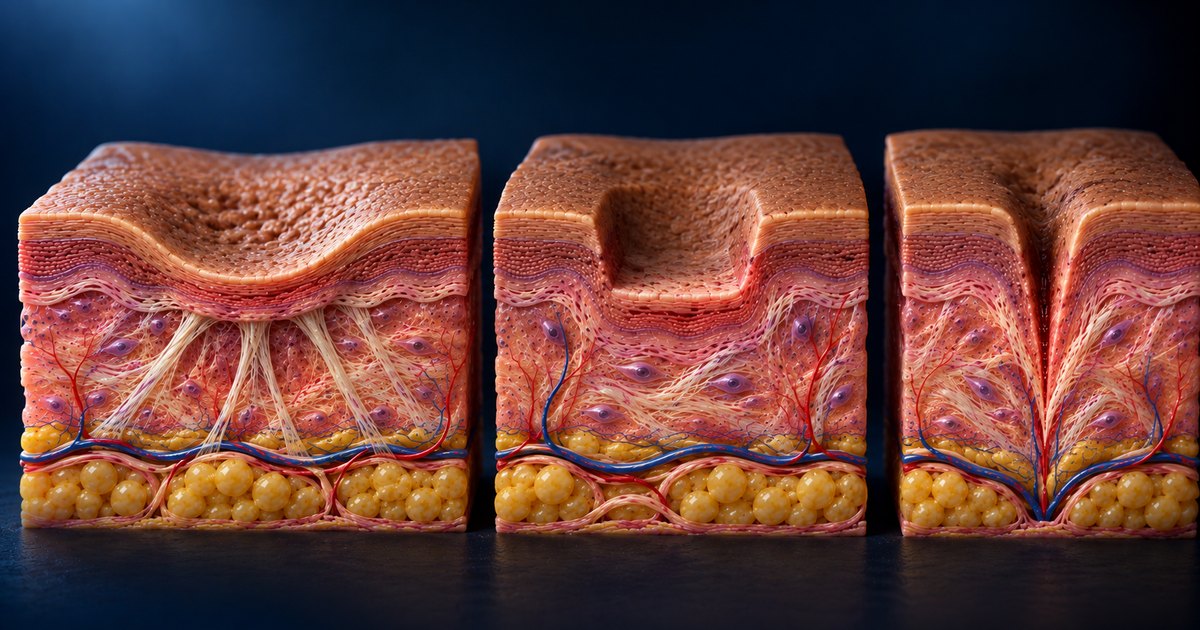
Illustration: how rolling, boxcar and ice-pick scars sit beneath the surface
Acne scars respond well to treatment once the scar type is identified first. Ice-pick, boxcar and rolling scars each have a different shape beneath the skin, and each has a different best-matched treatment — which is why scar mapping comes before any device is switched on. At Auraa we map the scar pattern, settle any active acne, then build a staged plan combining MNRF, fractional CO₂ laser, subcision, microneedling and TCA CROSS as your scars require. Most courses run three to six sessions four to six weeks apart, and improvement continues for months after the last one.
Marks and scars are two different things
This is the most useful distinction on the whole page, and it is good news for most people who read it.
A mark is a change in colour on skin that is still smooth. Brown marks are post-inflammatory hyperpigmentation; pink or red marks are post-inflammatory erythema. Both are flat. Run a finger over them and the surface feels normal. Marks fade — with time, with photoprotection, and considerably faster with treatment.²
A scar is a change in the texture of the skin. The surface is dented, pitted or raised, and it stays that way under any lighting. This is where collagen was lost or laid down unevenly while the acne was healing.¹
A great many people who come to us convinced they have acne scars turn out to have marks, or mostly marks with a few genuine scars among them. That assessment alone changes the plan, the timeline and the cost — which is why we do it first.
The three types of atrophic acne scar
Atrophic — indented — scars are the most common type, and they come in three recognised shapes.¹ Each one sits differently beneath the surface, and that shape is what decides which treatment reaches it.
| Ice-pick | Boxcar | Rolling | |
|---|---|---|---|
| What you see | Small, very narrow deep pits | Round or oval dents with defined edges | Broad, soft, wave-like dips |
| Shape below the surface | Narrow and deep, like a puncture | Wider, with steep straight walls | Shallow, tethered down from underneath |
| Usual sites | Cheeks, temples | Cheeks, temples, jawline | Cheeks, lower face |
| Best-matched approach | TCA CROSS, focused fractional CO₂ | Fractional CO₂, MNRF, microneedling | Subcision first, then MNRF or microneedling |
Almost nobody has only one type. Most faces carry a mixture, often alongside marks, which is exactly why a single device used across the whole face gives an uneven result — and why a mapped, combined plan gives a better one.
Raised scars — hypertrophic and keloid — behave differently again and are assessed separately. If you have these, Dr. Fatima will talk you through the specific approach for them at your consultation.
Scar mapping: the step that shapes everything
Your first visit is an assessment, not a sales conversation.
The scar map. We work across the face region by region and record which scar types are present, how deep they sit and how they are distributed. Side lighting shows texture that flat lighting hides.
Marks versus texture. Separating the two tells us how much of what you see will fade on its own with the right skincare, and how much needs a device.
Acne status. Whether anything is still active, and what is driving it.
Skin type and history. How your skin has responded to previous procedures, and how readily it pigments afterwards.
Baseline photography, in standardised lighting, so progress is measured rather than remembered. Scar improvement is gradual, and photographs taken three months apart are far more honest than memory.
Active acne is treated first
Scar work is most effective on skin that is no longer breaking out. New lesions appearing during a resurfacing course create new marks to treat, and the plan ends up chasing itself.
So if acne is still active, we settle that first. For some people that is a few weeks of a prescribed routine; for others it is a longer medical course. Either way it is time well spent — stable skin responds better to every scar treatment that follows, and it protects the investment you are about to make.
Treatment options at Auraa
We hold several devices rather than one, which means your scars decide the treatment rather than the treatment deciding what we can address.
MNRF — microneedling radiofrequency
Insulated microneedles carry radiofrequency energy to a set depth in the dermis and release it there, so the collagen-stimulating heat is delivered where the scar sits while the surface stays comparatively protected. That combination is particularly well suited to melanin-rich skin, and it is one of our most-used tools for boxcar and rolling scars.
Fractional CO₂ laser
Fractional resurfacing treats the skin in a grid of microscopic columns, leaving untreated skin in between to drive healing. It is the most powerful remodelling option we hold and it is the strongest choice for deeper and more defined scars. In Indian skin we run it with conservative, considered settings and prepare the skin beforehand — the result comes from the sum of a planned course, not from any one aggressive session.
Subcision
Rolling scars are tethered — fibrous strands pull the skin down from beneath. No amount of surface resurfacing lifts a scar that is anchored. Subcision releases those tethers so the skin can sit level again, and it is why rolling scars that have resisted laser elsewhere often improve once this step is added.
Microneedling with Dermapen
Controlled micro-channels at a depth matched to the scar, stimulating collagen with very little surface disruption. We use it for shallower texture, for blending between stronger sessions, and for patients who need a gentler route.
Chemical peels and TCA CROSS
Medical peels improve overall texture and lift the pigment component. TCA CROSS is a precise technique in which a high-strength agent is applied to the base of an individual ice-pick scar only — reaching narrow, deep scars that no fractional device can address — prompting that single scar to remodel upward.
Laser toning for the marks
Where brown marks sit alongside the scars, Q-switched Nd:YAG laser toning addresses the colour while the other treatments address the texture. Patients often notice this part first, because colour change is visible sooner than collagen change.
Why combinations work better than any single device
This is the clearest finding in the acne-scar literature, and it is worth knowing before you compare clinics.
Because scar types differ in shape, procedures suited to one subtype are not suited to another — so combining procedures leads to better outcomes, particularly where deeper scars of several types sit alongside fine textural irregularity.³ Combining microneedling and CO₂ laser can also mean fewer total sessions, lower overall cost and better comfort than pushing a single modality further than it is designed to go.³ Combinations built around subcision, TCA CROSS and microneedling have likewise shown consistently high patient satisfaction.³
Combining RF microneedling with fractional CO₂ laser has been reviewed specifically, and found to be a safe and effective approach for acne scarring, with noticeable improvement in scar severity after treatment and a short recovery — patients in that series returned to normal activities within seven days.⁴
The practical message: a clinic that offers you one device for every scar on your face is offering you the device it owns, not the plan your skin needs.
Indian skin, and why settings matter more than brand names
Most Indian skin falls into Fitzpatrick types IV to VI. More melanin means skin that ages slowly and tolerates sun well — and pigment cells that respond readily to heat and inflammation.
The practical consequence is that measured and repeated outperforms aggressive. Conservative settings across a planned course achieve what one strong session cannot, keep the skin comfortable throughout, and keep the result clean. Every course here begins with a test area, settings are built up gradually, and your skin is prepared in advance and supported afterwards.
What a course looks like
Typically three to six sessions, spaced four to six weeks apart, with the exact number confirmed after your scar map rather than quoted before it.
Improvement continues after the course ends. Collagen remodelling runs for months, so the face you see three months after your last session is better than the face you saw the week after it. This is the single most common surprise for patients, and a welcome one.
Marks improve first, texture follows. Colour change shows within weeks; texture change is measured across months.
Photographs decide, not impressions. We compare standardised images at each review, which is also how we confirm the plan is working and adjust it if a particular area needs more attention.
You receive a written plan with clear costs after your assessment, and no pressure-selling at any point.
Holding your result
Keep the acne settled. This is the one that protects everything else — new lesions make new scars.
Daily photoprotection. It keeps the colour result clean while the texture result develops.
A simple maintenance routine, usually a retinoid-based plan prescribed for your skin, which continues the collagen work between and after sessions.
Periodic review, so any area that needs a top-up is caught while it is still a small job.
Read more on acne and scarring
- Acne Scar Treatment: Which Treatment Works for Which Scar
- How Many Sessions Does Acne Scar Treatment Take?
- MNRF vs Fractional CO2 for Acne Scars: How We Choose
- Microneedling Depth by Indication: A Practitioner Reference
- Melasma & Pigmentation Treatment in Hyderabad
Book a consultation
Auraa Skincare Clinic & Institute
3rd Floor, Door 302, Falcon Valley Rd, beside Narayanamma Engineering College, opp. DMart, Ambedkar Nagar, Film Nagar, Hyderabad, Telangana 500008
Coming from the Toli Chowki side, continue through towards Shaikpet and Film Nagar — we are on Falcon Valley Road, directly opposite DMart.
Mon–Sat 10:30 AM – 8:00 PM · Sunday by appointment
Consultations in English, Hindi, Urdu and Telugu
Frequently asked questions
How many sessions does acne scar treatment take?
Most courses run three to six sessions spaced four to six weeks apart. The number depends on your scar types, how deep they sit and how much of the face is involved, which is why it is confirmed after your scar map rather than quoted before it. Improvement continues for several months after the final session as collagen remodelling completes.
Which treatment is best for acne scars?
There is no single best treatment — there is a best match for each scar type. Ice-pick scars respond to TCA CROSS and focused fractional CO2; boxcar scars to fractional CO2, MNRF and microneedling; rolling scars need subcision to release the tethering first. Because most faces carry a mixture, combination plans consistently outperform any single device.
Can acne scars be removed completely?
Significant, visible improvement is realistically achievable and that is what a well-matched plan delivers. Scar treatment remodels tissue rather than erasing it, so the honest goal is skin that reads as smooth in normal light and photographs well — which for most patients is exactly what they came for. Your expected result is shown to you with photographs at your assessment.
Is acne scar treatment safe for Indian skin?
Yes, when the settings are built for melanin-rich skin. We use conservative settings across a planned course rather than a single strong session, start with a test area, prepare the skin beforehand and support it afterwards. This approach suits Fitzpatrick IV to VI particularly well.
Do I need to clear my acne before treating the scars?
Active acne is settled first. New lesions appearing during a resurfacing course create new marks, so the plan ends up chasing itself. Depending on your skin this may be a few weeks of a prescribed routine or a longer medical course — and stable skin responds better to every scar treatment that follows.
How much does acne scar treatment cost in Hyderabad?
It depends on your scar map and the plan built around it, which is why we do not publish a single price. After your assessment you receive a written plan with clear costs for the full course, so you know the total before you begin.
References
- Connolly D, Vu HL, Mariwalla K, Saedi N. Acne Scarring — Pathogenesis, Evaluation, and Treatment Options. Journal of Clinical and Aesthetic Dermatology. 2017;10(9):12–23. https://pmc.ncbi.nlm.nih.gov/articles/PMC5749614/
- Lawrence E, Syed HA, Al Aboud KM. Postinflammatory Hyperpigmentation. StatPearls, updated November 2024. https://www.ncbi.nlm.nih.gov/books/NBK559150/
- Meghe S, Saoji V, Madke B, Singh A. Efficacy of Microneedling and CO2 Laser for Acne Scar Remodelling: A Comprehensive Review. Cureus. 2024;16(2):e55092. https://pmc.ncbi.nlm.nih.gov/articles/PMC10978375/
- Mandavia R, Cariati M, Shahidi S, Spencer C, Somenek M, Lapa T. Combination radiofrequency microneedling and carbon dioxide laser for acne scarring: A systematic review and retrospective case series across two centers. Journal of Cosmetic Dermatology. 2022;21(11):5672–5679. https://pubmed.ncbi.nlm.nih.gov/35896510/
Every source above was opened and checked against the claim it supports before publication.
Medically reviewed by Dr. Fatima Sajeeda — Integrative Medicine Practitioner, Expert in Medical Aesthetics, Cosmetologist & Trichologist · 16+ years · International Faculty, IEB UK · Auraa Skincare Clinic, Film Nagar, Hyderabad
Book an Acne Scar Assessment on WhatsApp← Back to site