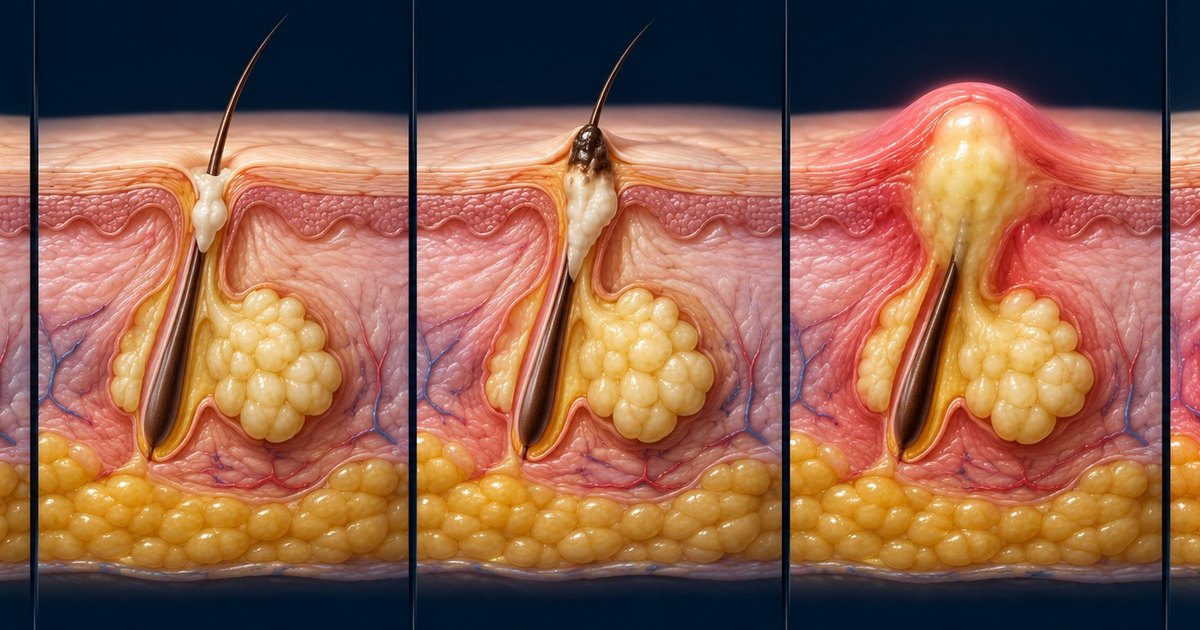
Illustration: how a blocked follicle progresses to an inflamed lesion
Acne is a medical condition, and it responds to a medical plan. At Auraa we assess which kinds of lesions you actually have — comedonal, inflammatory, nodulocystic or hormonal — then build a combination plan around that, supported by peels, carbon laser and clinical extractions. The point most relevant to Indian skin: treating acne early is the best acne-mark and acne-scar prevention there is. In Fitzpatrick IV to VI skin, post-inflammatory pigmentation is especially common, often more severe, and can persist for months or years if left untreated. Expect fewer new lesions by six to eight weeks and the clearest change at three to four months.
Acne is not one condition
The word covers several different presentations, and they need different plans. Treating all of them the same way is the most common reason acne treatment stalls.
| Comedonal | Inflammatory | Nodulocystic | Hormonal pattern | |
|---|---|---|---|---|
| What you see | Blackheads and whiteheads | Red papules and pustules | Deep, tender lumps | Deep spots along jaw and chin |
| Where | Forehead, nose, chin | Cheeks, forehead, chin | Cheeks, jawline, back | Lower face, jawline, neck |
| Scarring risk | Low | Moderate | High — treat promptly | Moderate to high |
| Core approach | Topical retinoid-led | Combination topical therapy | Medical management, early | Treat the hormonal driver too |
Most people have a mixture, and the mixture changes over time. That is why the plan is reviewed rather than set once.
Why treating acne early matters more in Indian skin
This is the single most important thing on the page.
In Fitzpatrick skin types IV to VI, post-inflammatory hyperpigmentation is especially common and often more severe, and the marks may persist for months or even years if left untreated.¹
So for Indian skin, acne leaves two separate problems behind: the marks, and the scars. Both are far easier to prevent than to treat.
The practical consequence: the best acne-mark treatment and the best acne-scar treatment are both treating the acne properly, now. Every week of active inflammation adds to what has to be cleared later.
If you are reading this while deciding whether it is worth coming in — it is, and earlier is cheaper than later.
How we assess your acne
Lesion type and distribution. Which kinds are present, where, and in what proportion. This decides the plan.
History. How long, what you have used, what helped, what made it worse, and anything that triggers a flare.
Hormonal context. Cycle pattern, PCOS, thyroid, pregnancy or planning, and any medications that affect skin.
Current skincare. Frequently part of the problem — over-cleansing, harsh scrubs and heavy occlusive products all feature regularly.
Marks and scars, assessed separately. Flat brown or red marks fade; textural scars do not. Knowing the split changes both the plan and your expectations.
Standardised photography, so progress is measured rather than remembered.
Routine hormone testing is not recommended for most people with acne. It is appropriate where there are additional signs of androgen excess — and that is a judgement made at the consultation rather than a blanket test.²
Treatment at Auraa
Medical treatment — the foundation
Acne is a medical condition and the backbone of any real plan is medical. The categories used, with the evidence behind them:
- Topical retinoids — central to both clearing acne and keeping it clear, used alone in mainly comedonal acne or combined where inflammation is present²
- Benzoyl peroxide — effective on its own in mild acne, and specifically recommended alongside any antibiotic because it prevents bacterial resistance²
- Topical antibiotics — effective, but never used alone, because of resistance²
- Azelaic acid — a useful adjunct, and specifically recommended for the post-inflammatory pigmentation that matters so much in Indian skin²
- Oral antibiotics — for moderate to severe inflammatory acne, always with a topical alongside, for the shortest effective period, reviewed at three to four months²
- Hormonal treatment — combined oral contraceptives are effective for inflammatory acne in women, and spironolactone is useful in selected cases²
- Oral isotretinoin — the recognised treatment for severe nodular acne, and appropriate for moderate acne that resists treatment or that is causing physical scarring or psychological distress²
The guideline principle that matters most: combination therapy should be used in the majority of patients, because agents acting on different parts of the process do better together than any one alone.²
Medical peels
Used as an adjunct alongside the medical plan rather than as the treatment itself — we are straightforward about that, because the evidence for peels as routine acne therapy is limited.² Where they genuinely earn their place is on congestion and on the pigment left behind, and there the evidence in skin of colour is better.¹
In melanin-rich skin, gentler peels repeated across a course are the right approach; stronger agents carry more risk in darker phototypes and we do not use them.¹
Carbon laser facial
Comfortable, no downtime, and well suited to oily, congested skin with visible pores. A useful supporting treatment between medical reviews.
Clinical extractions and HydraFacial
Professional clearing of comedones, done properly and sterile, rather than picking at home — which is itself a significant cause of both marks and scars.
LED therapy
A calming adjunct for inflamed skin, used alongside the plan.
Treating the marks
Once the acne is settling, the pigment is addressed directly. First-line options in skin of colour are topical therapy plus consistent photoprotection — hydroquinone, retinoids, azelaic acid, cysteamine and tranexamic acid are all established here, with laser toning and peels added as appropriate.¹
Full detail is on our pigmentation page.
Hormonal acne
If your breakouts sit along the jawline and chin, come as deep tender spots, and flare with your cycle, the hormonal pattern is worth taking seriously.
It responds — but it responds best when the hormonal driver is addressed alongside the skin. Where PCOS is involved, that means coordinating with your own doctor or gynaecologist rather than treating the face in isolation. The same logic applies to PCOS-related facial hair, covered on our laser hair removal page.
Diet — the honest answer
You will have been told many things. Here is what the guideline actually says: no specific dietary changes are recommended in the management of acne, though emerging data suggest high glycaemic index diets may be associated with it, and limited evidence suggests some dairy — particularly skim milk — may have an influence.²
In practice: no food is causing your acne, and cutting out entire food groups is unlikely to clear it. If you notice a consistent personal trigger, that is worth mentioning at your consultation. Beyond that, the treatment is the treatment.
What a course looks like
Acne treatment takes months, not weeks. Skin turnover and the lifecycle of a lesion both set that pace, and no plan outruns it.
Weeks 2 to 4: often a settling-in period as the skin adjusts to prescribed actives. This is expected and is not the treatment failing.
Weeks 6 to 8: noticeably fewer new lesions. This is the first real signal.
Months 3 to 4: the clearest change, assessed against your baseline photographs. Oral treatment, where used, is reviewed here.²
Then maintenance. This is the part people skip, and skipping it is the most common reason acne returns. Maintenance is usually a simple topical routine and it is what holds the result.
Then, and only then, the scars
Scar treatment works best on skin that is no longer breaking out. New lesions during a resurfacing course create new marks, and the plan ends up chasing itself.
So we settle the acne first, then map the scars. Full detail on that stage is on our acne scar treatment page.
Read more
- Acne Scar Treatment in Hyderabad
- The monsoon breakout that is not acne at all
- Why Your Dark Spots Keep Coming Back
- HydraFacial & Medical Facials in Hyderabad
Book a consultation
Auraa Skincare Clinic & Institute
3rd Floor, Door 302, Falcon Valley Rd, beside Narayanamma Engineering College, opp. DMart, Ambedkar Nagar, Film Nagar, Hyderabad, Telangana 500008
Coming from the Toli Chowki side, continue through towards Shaikpet and Film Nagar — we are on Falcon Valley Road, directly opposite DMart.
Mon–Sat 10:30 AM – 8:00 PM · Sunday by appointment
Consultations in English, Hindi, Urdu and Telugu
Frequently asked questions
How long does acne treatment take to work?
Months rather than weeks. Expect a settling-in period in the first two to four weeks, noticeably fewer new lesions by six to eight weeks, and the clearest change at three to four months, assessed against baseline photographs. Oral treatment, where used, is reviewed at three to four months.
Will my acne marks go away on their own?
Flat brown or red marks do fade, but in Fitzpatrick IV to VI skin post-inflammatory hyperpigmentation is especially common and often more severe, and can persist for months or even years untreated. Treating it actively, with photoprotection, is considerably faster than waiting.
Should I treat my acne or wait for it to settle?
Treat it. Every week of active inflammation adds to the marks and scars that have to be cleared later, and that effect is stronger in Indian skin. Early treatment is both the best acne-mark prevention and the best acne-scar prevention there is.
Do I need antibiotics or isotretinoin?
That depends entirely on your presentation. Guidelines reserve oral antibiotics for moderate to severe inflammatory acne, always alongside topical treatment and for the shortest effective period. Isotretinoin is the recognised treatment for severe nodular acne and for moderate acne that resists treatment or is causing scarring or distress. Dr. Fatima, or your own doctor, will assess and prescribe accordingly.
Can facials or peels clear my acne?
They help with congestion and with the marks left behind, but the evidence for peels as routine acne therapy is limited, so we use them as an adjunct rather than as the treatment itself. The backbone of a real plan is medical. Any clinic selling you a course of facials as acne treatment is selling the wrong thing.
Does diet cause acne?
Guidelines do not recommend any specific dietary changes for acne. Emerging data suggest high glycaemic index diets may be associated with it, and limited evidence points to some dairy, particularly skim milk. No food is causing your acne, and cutting out food groups is unlikely to clear it.
Do I need hormone tests?
Routine hormonal testing is not recommended for most people with acne. It is appropriate where there are additional signs of androgen excess, which is a judgement made at your consultation rather than a blanket test.
How much does acne treatment cost in Hyderabad?
It depends on your presentation and the plan built around it. After your assessment you receive a written plan with clear costs. What shapes that figure is set out on our treatment cost page.
References
- Post-inflammatory Hyperpigmentation in Skin of Color: Emerging Therapies and Treatment Algorithms. Cureus. 2026;18. doi:10.7759/cureus.107234. PIH is especially common and often more severe in Fitzpatrick IV–VI and may persist for months or years untreated; hydroquinone, retinoids, azelaic acid, cysteamine and tranexamic acid remain first-line alongside photoprotection. https://pmc.ncbi.nlm.nih.gov/articles/PMC13180417/
- American Academy of Dermatology. Guidelines of Care for the Management of Acne Vulgaris. Combination therapy in the majority of patients; benzoyl peroxide to prevent bacterial resistance; topical antibiotics not as monotherapy; azelaic acid for post-inflammatory dyspigmentation; systemic antibiotics for the shortest duration with review at 3–4 months; isotretinoin for severe nodular acne and for scarring or distressing treatment-resistant acne; limited evidence for peels as routine acne therapy; no specific dietary changes recommended. https://www.guidelinecentral.com/guideline/21839/
Every source above was opened and checked against the claim it supports before publication.
Medically reviewed by Dr. Fatima Sajeeda — Integrative Medicine Practitioner, Expert in Medical Aesthetics, Cosmetologist & Trichologist · In medical practice since 2005, aesthetic medicine since 2008 · International Faculty, IEB UK · Auraa Skincare Clinic, Film Nagar, Hyderabad
Book an Acne Consultation on WhatsApp← Back to site