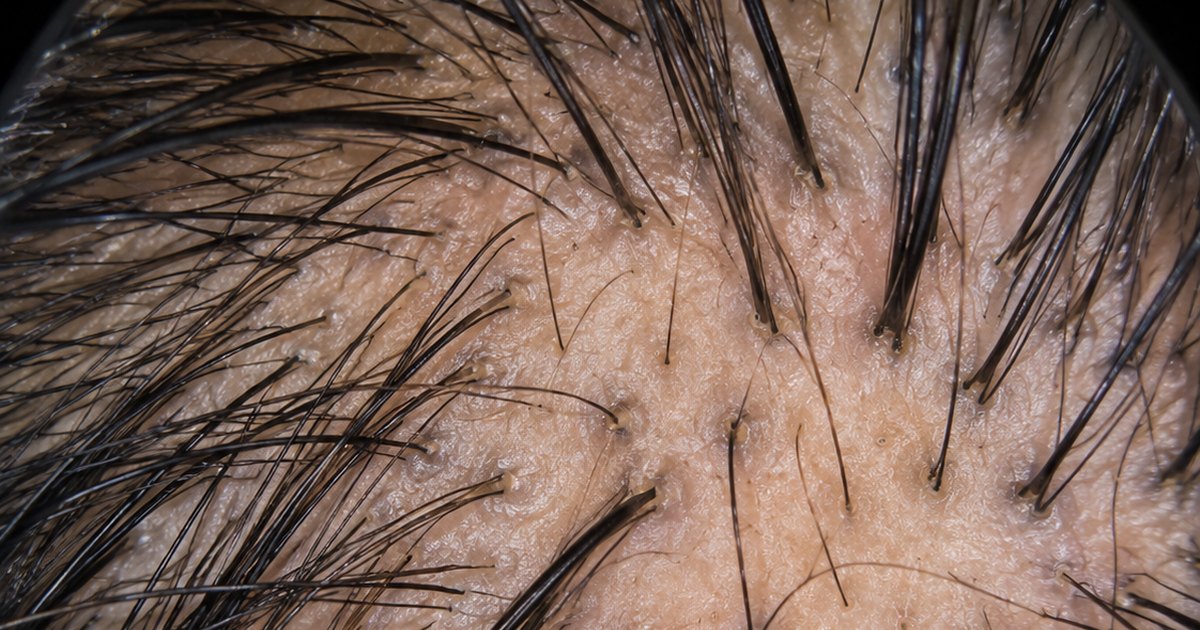
Trichoscopy decides whether regenerative treatment will help you at all
PRP, GFC and exosome therapy support hair follicles that are thinning but still present. The strongest evidence is for PRP: a meta-analysis of nine randomised controlled trials covering 238 patients found increased hair density at three and six months versus placebo, with no serious adverse reactions. At Auraa no injection happens before an assessment — history, scalp examination, trichoscopy and blood work where indicated — because if your hair loss is a shedding episode that will recover on its own, you do not need a course of injections and we will say so.
Who this is for
Regenerative hair treatment is for people whose hair is thinning but still present. It works by supporting follicles that are still alive and producing finer hair than they used to.
It suits you if: your parting has widened, your ponytail feels thinner, you are in the earlier stages of pattern hair loss, or you want to support hair while a medical plan does the longer-term work.
It is not the right treatment if: the area is completely bald with no follicles left, or if your hair loss turns out to be something else entirely — which is exactly why assessment comes before any injection.
How we assess you first
This is the step that decides whether regenerative treatment will help you at all, and no reputable clinic should skip it.
History. When it started, what was happening three to four months before, family pattern, diet, medications, and for women the hormonal picture including thyroid and pregnancy.
Scalp examination and pull test. Where the thinning sits, the condition of the scalp itself, and how readily hairs release.
Trichoscopy. Magnified examination showing whether hair calibre has become uneven, how many hairs emerge per follicular unit, and whether follicles are open and healthy. This is how we tell active thinning from a shedding episode that will recover on its own.
Blood work where indicated — iron studies, thyroid function, vitamin D and B12 are the common ones, because correcting a documented deficiency is one of the most reliable things that can be done for hair. Results needing medical management are reviewed with your own doctor.
Baseline photography in standardised lighting, because hair moves slowly and photographs at three and six months are far more honest than the mirror.
If the assessment shows a shedding episode after illness or childbirth rather than pattern thinning, we will tell you so — that recovers on its own and does not need a course of injections.
What the treatment involves
PRP — platelet-rich plasma
Your own blood is drawn, spun to concentrate the platelets and the growth factors they carry, and that concentrate is delivered into the scalp. It is the most studied of the three options.
A systematic review and meta-analysis of nine randomised controlled trials covering 238 patients found PRP increased hair density at both three and six months compared with placebo, with no serious adverse reactions reported.¹ The same analysis is clear that hair count and hair diameter did not separate significantly from placebo — so density is the outcome the evidence supports, and density is what we set as the expectation.¹
GFC — growth factor concentrate
A more refined preparation, again from your own blood, processed to yield a higher and more consistent concentration of growth factors. In a single-centre study of patients with pattern hair loss given three injections three to four weeks apart, hair density and hair growth ratio improved significantly by three months, sustained at six months and rated positively by both patients and independent assessors.²
That study was retrospective and single-arm, so the evidence base behind GFC is younger and smaller than PRP’s. We say so plainly rather than presenting it as the premium upgrade.
Exosome therapy
The newest of the three. Exosome preparations carry signalling material intended to influence the pathways involved in hair follicle cycling, and the early clinical work is encouraging. It also has the smallest evidence base — a 2025 systematic review identified eleven published clinical investigations, of which two were randomised controlled trials.³
We offer it selectively, with an honest account of where the science stands. It is an advanced option, not a replacement for the fundamentals.
What works alongside it
Regenerative treatment does best as part of a plan rather than on its own. That usually means medical treatment for pattern hair loss, treating any scalp condition, and correcting nutritional deficiencies. Full detail on the wider plan is on our hair loss treatment page.
What a session is like
Blood draw for PRP or GFC, as you would have for any blood test, then processing while you wait.
Scalp preparation and a topical anaesthetic for comfort.
Delivery into the thinning areas in a mapped pattern. Most people describe brief pressure rather than pain.
Duration: about 45 to 60 minutes including preparation.
Afterwards: mild scalp tenderness for a day is normal. You can drive yourself home and return to work.
Aftercare
Do not wash your hair for the rest of the day. Normal washing resumes the next morning with a gentle shampoo.
No swimming, sauna, steam or heavy exercise for 24 hours.
No hair colouring or chemical treatment for about a week.
Avoid direct sun on the scalp for a day or two.
Stay with your medical plan between sessions — that is what the injections are supporting.
Expect reduced shedding first. Density change is assessed at three months and again at six, against your baseline photographs.
How many sessions will I need?
Number of sessions: usually a course of four to six sessions about four weeks apart, followed by maintenance. This varies by person and is confirmed after your assessment, never quoted beforehand.
Read more
- PRP vs GFC vs Exosomes: A Doctor’s Honest Comparison
- Sudden Hair Fall After Illness, Fever or Childbirth
- Hair Loss Treatment in Film Nagar, Hyderabad
- Acne Scar Treatment
Book a consultation
Auraa Skincare Clinic
3rd Floor, Door No. 302, Falcon Valley Road, beside Narayanamma Engineering College, Opp. DMart, Ambedkar Nagar, Film Nagar, Hyderabad, Telangana 500008
Coming from the Toli Chowki side, continue through towards Shaikpet and Film Nagar — we are on Falcon Valley Road, directly opposite DMart.
Phone +91 91008 76662
Hours Mon–Sat 11:00 AM – 7:00 PM · Sunday 11:30 AM – 7:00 PM
Consultations in English, Hindi, Urdu and Telugu
Frequently asked questions
Does PRP actually work for hair loss?
The evidence supports increased hair density. A systematic review and meta-analysis of nine randomised controlled trials covering 238 patients found PRP increased hair density at both three and six months compared with placebo, with no serious adverse reactions. The same analysis found hair count and diameter did not separate significantly from placebo, so density is the outcome we set as the expectation.
Which is better, PRP, GFC or exosomes?
PRP has the largest evidence base. GFC is a more concentrated preparation with promising but younger evidence from a single-centre study showing significant density improvement by three months, sustained at six. Exosomes have the smallest evidence base, with eleven published clinical investigations identified in a 2025 review, only two of them randomised trials. Which suits you is decided at your assessment.
How many sessions will I need?
Usually a course of four to six sessions about four weeks apart, followed by maintenance. The number is confirmed after your assessment rather than quoted beforehand, because it depends on the cause of your hair loss, how long it has been present and what else your plan includes.
Will it work if I am completely bald in that area?
No. Regenerative treatment supports follicles that are still alive and producing finer hair. Where an area has no follicles left, it cannot help, and we will tell you that at your assessment rather than sell you a course that cannot work.
Do I need blood tests before starting?
Often yes. Iron studies, thyroid function, vitamin D and B12 are the common ones, because correcting a documented deficiency is one of the most reliable things that can be done for hair. Dr. Fatima will advise which apply to you, and results needing medical management are reviewed with your own doctor.
References
- Platelet-Rich Plasma for Androgenetic Alopecia: A Systematic Review and Meta-Analysis of Randomized Controlled Trials. Journal of Cutaneous Medicine and Surgery. 2023;27(5):504–508. Nine trials, 238 patients; increased hair density at three and six months versus placebo; no serious adverse reactions. https://pubmed.ncbi.nlm.nih.gov/37533146/
- Evaluation of the safety and efficacy of concentrated growth factors for hair growth promotion in androgenetic alopecia patients: a retrospective single-centre, single-arm study. Journal of Cosmetic Dermatology. doi:10.1111/jocd.16519. https://www.ncbi.nlm.nih.gov/pmc/articles/PMC11626311/
- Exosome Therapy for Hair Loss: Research, Risks and Regulatory Status. American Hair Loss Association, updated October 2026. A 2025 systematic review identified eleven published clinical investigations, two of them randomised controlled trials. https://www.americanhairloss.org/hair-loss-treatment/regenerative-medicine/exosomes/
Every source above was opened and checked against the claim it supports before publication.
Medically reviewed by Dr. Fatima Sajeeda, Integrative Medicine Practitioner & Medical Aesthetics Expert — Cosmetologist & Trichologist · In medical practice since 2005, aesthetic medicine since 2008 · International Faculty, IEB UK · Auraa Skincare Clinic, Film Nagar, Hyderabad
Book a Hair Growth Consultation on WhatsApp← Back to site