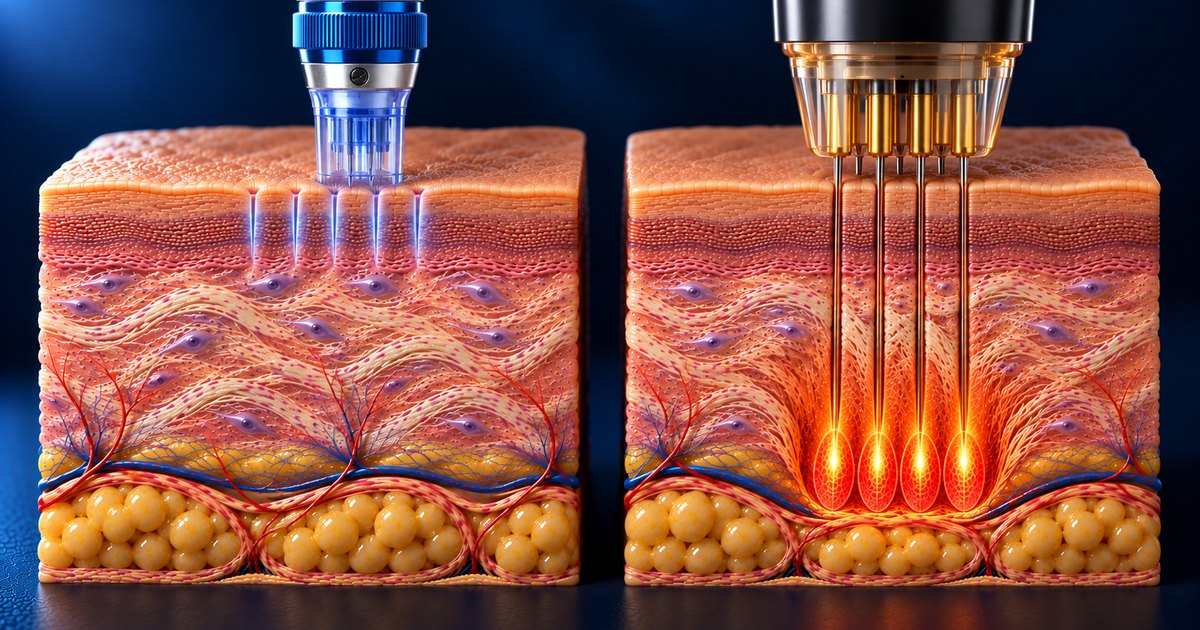
Illustration: microneedling channels compared with radiofrequency energy delivered at depth
Skin ageing is three separate changes — collagen and elastin reducing, texture and tone shifting, and support settling downward — and each needs its own treatment. At Auraa we assess which of the three is actually bothering you, then build a plan from MNRF, radiofrequency tightening, microneedling, fractional CO₂ and medical skincare. Indian skin ages differently, typically showing tone and firmness change before lines, so the plan is built around that rather than borrowed from a lighter-skin protocol. We do not offer injectables, which means the plan you are given is the one your skin calls for.
What actually makes skin look older
Three separate things change, and they are worth separating because each has its own treatment.
Collagen and elastin reduce. The scaffolding beneath the skin thins, so the surface loses firmness and fine lines appear. This is the structural change, and it is the one devices address.
Texture and tone change. Pores become more visible, surface roughness increases, and pigment accumulates unevenly from years of sun exposure.
Support shifts. Fat pads and tissue settle downward, which softens the jawline and deepens folds.
Most people arrive describing all three as one problem — “I look tired.” A good assessment separates them, because a plan that addresses laxity does little for pigment, and a plan that addresses pigment does nothing for laxity.
Indian skin ages differently, and mostly in your favour
Most Indian skin falls into Fitzpatrick types IV to VI. More melanin means more natural protection from ultraviolet light, and the practical consequence is well recognised: fine lines and wrinkles typically appear later and less prominently than in lighter skin types.
What tends to show first instead is pigment — uneven tone, dark patches, dullness — and volume and laxity changes around the mid-face and jawline.
This matters for how a plan is built. An anti-ageing plan borrowed from a lighter-skin protocol will often over-treat lines that were never your main concern and under-treat the tone and firmness changes that are. Ours is built the other way round.
Treatment options at Auraa
MNRF — microneedling radiofrequency
Our primary tool for laxity. Insulated microneedles deliver radiofrequency energy at a set depth in the dermis, placing the collagen-stimulating heat exactly where the structural change has happened while the surface stays comparatively protected — which is what makes it well suited to melanin-rich skin.
The evidence base is substantial. A systematic review covering 41 studies, including 15 randomised controlled trials, across diverse geographies and Fitzpatrick skin types, found that for skin laxity and photoageing, radiofrequency microneedling improved wrinkle scales, dermal density and submental volume — with the changes evidenced histologically rather than by appearance alone.¹
Dermal density is the measure worth noticing there. It means the skin became structurally denser, not just smoother-looking.
Radiofrequency skin tightening
Non-needle radiofrequency delivers controlled heat through the surface to the deeper layers, prompting existing collagen to contract and new collagen to form. It is comfortable, needs no recovery time, and is delivered as a planned course.
It suits early laxity well, and it pairs naturally with MNRF — one working at depth through needles, the other working more broadly through the surface.
Microneedling with Dermapen
Controlled micro-channels at a depth matched to the concern, stimulating collagen with minimal surface disruption. We use it for fine lines, texture, pores and overall skin quality, and as the gentler route for sensitive skin.
Fractional CO₂ laser
The most powerful resurfacing option we hold, used where texture and deeper lines need genuine remodelling. In Indian skin it is run with conservative settings, with the skin prepared beforehand and supported afterwards.
Medical skincare
The foundation of every anti-ageing plan and the part that works every single day between sessions. Retinoids, antioxidants, peptides and daily photoprotection do more of the long-term work than any device.
Peels, HydraFacial and Oxygenio
Surface-level treatments that improve clarity, hydration and tone. They are not structural treatments and we do not present them as such — but they make a visible difference to how skin looks and they keep the result polished between the deeper sessions. More on these is on our HydraFacial and medical facials page.
Matching the treatment to the concern
| What you want improved | Best-matched approach |
|---|---|
| Early jawline and neck laxity | MNRF, radiofrequency tightening |
| Fine lines around eyes and mouth | Microneedling, fractional CO₂, medical skincare |
| Open pores and surface texture | MNRF, microneedling, peels |
| Uneven tone and dullness | Laser toning, peels, medical skincare |
| Overall skin quality and glow | HydraFacial, Oxygenio, medical skincare |
| Dark patches and pigmentation | See our pigmentation page |
Most plans combine two or three of these. Very few people need only one.
What we do not offer, and why that is useful to know
We do not offer injectables. No botulinum toxin, no dermal fillers, no threads.
We say this plainly because it tells you something about the advice you will get here. When a clinic’s anti-ageing revenue depends on injectables, every consultation tends to arrive at injectables. Ours does not, so the plan you are offered is the one your skin actually calls for.
If your assessment suggests an injectable treatment would serve you better than anything we hold, we will tell you that too.
How we assess you
What is actually bothering you. Usually more specific than “ageing” once we talk it through — the jawline in photographs, the texture under make-up, the tone in daylight.
Skin examination. Firmness, texture, pore size, pigment distribution, sun damage and barrier condition, region by region.
Your history. Previous treatments and how your skin responded, current skincare, medications, hormonal factors and sun exposure.
Standardised photography. Anti-ageing change is gradual, and photographs taken three months apart are far more honest than the mirror.
A staged plan — what we treat first, what follows, what is maintenance, and what it will cost, in writing.
What a course looks like
Typically four to six sessions for a device-based course, spaced four to six weeks apart.
The result builds after the course ends. Collagen remodelling runs for months, so the honest assessment point is three months after your final session — not the week after it.
Texture and tone improve first, usually within weeks. Firmness follows across months.
Then maintenance. Typically one or two sessions a year alongside a home routine, which is what holds the result.
Your own session count is confirmed after your assessment, never quoted before it.
Realistic expectations, set honestly
Non-surgical treatment improves skin quality, firmness and texture. It is genuinely good at that, and for most people in their thirties, forties and fifties it is exactly what they were after — skin that looks rested, even and firm.
What it does not do is reposition tissue that has descended significantly. Where that is the main concern, no device will match what surgery achieves, and we will say so rather than sell you a course that cannot deliver it.
Starting earlier is also easier than correcting later. Maintaining collagen takes less work than rebuilding it, which is why a light maintenance plan in your thirties is better value than an intensive one in your fifties.
Read more
- Microneedling Depth by Indication: A Practitioner Reference
- MNRF vs Fractional CO2: How We Choose
- Melasma & Pigmentation Treatment in Hyderabad
- Acne Scar Treatment in Hyderabad
Book a consultation
Auraa Skincare Clinic & Institute
3rd Floor, Door 302, Falcon Valley Rd, beside Narayanamma Engineering College, opp. DMart, Ambedkar Nagar, Film Nagar, Hyderabad, Telangana 500008
Coming from the Toli Chowki side, continue through towards Shaikpet and Film Nagar — we are on Falcon Valley Road, directly opposite DMart.
Mon–Sat 10:30 AM – 8:00 PM · Sunday by appointment
Consultations in English, Hindi, Urdu and Telugu
Frequently asked questions
What is the best anti-ageing treatment for Indian skin?
There is no single best treatment, but MNRF is our most-used tool for laxity in Fitzpatrick IV to VI skin, because the insulated needles place energy at depth while leaving the surface comparatively protected. A systematic review of 41 studies including 15 randomised trials found radiofrequency microneedling improved wrinkle scales, dermal density and submental volume for laxity and photoageing, with histological evidence. Most plans combine it with medical skincare and a tone-focused treatment.
Does skin tightening actually work without surgery?
Yes, for skin quality, firmness and texture — which is what most people in their thirties, forties and fifties actually want. What non-surgical treatment does not do is reposition tissue that has descended significantly. Where that is the main concern we will tell you plainly rather than sell a course that cannot deliver it.
How many sessions will I need?
Typically four to six for a device-based course, spaced four to six weeks apart, then maintenance of one or two sessions a year. The result continues building for months after the course ends, so the honest assessment point is the three-month photograph.
Do you offer Botox or fillers?
No. We do not offer botulinum toxin, dermal fillers or threads. We say so plainly because it means our anti-ageing advice is not shaped by injectable revenue. If your assessment suggests an injectable would serve you better than anything we hold, we will tell you that too.
When should I start anti-ageing treatment?
Earlier is easier. Maintaining collagen takes less work than rebuilding it, so a light maintenance plan in your thirties is better value than an intensive one later. That said, treatment works well at any stage — it simply takes a longer course when there is more to address.
Is radiofrequency safe for darker skin?
Radiofrequency energy is not absorbed by melanin the way laser light is, which is one reason radiofrequency-based treatments suit Fitzpatrick IV to VI skin well. The systematic review cited on this page covered studies spanning diverse geographies and Fitzpatrick skin types. Every course here still begins with an assessment and appropriate settings for your skin.
How much does anti-ageing treatment cost in Hyderabad?
It depends on which concerns your assessment identifies and the plan built around them, which is why we do not publish a single price. After your consultation you receive a written plan with clear costs for the full course.
References
- Effectiveness of Radiofrequency Microneedling in the Treatment of Dermatological Conditions: A Systematic Review. Aesthetic Plastic Surgery, vol. 50. Forty-one studies (15 randomised controlled trials, 19 prospective non-randomised, 5 cohorts, 2 case series), searches January 2015 to July 2025, PROSPERO CRD420251089393. https://doi.org/10.1007/s00266-026-05834-y
- Mandavia R, Cariati M, Shahidi S, Spencer C, Somenek M, Lapa T. Combination radiofrequency microneedling and carbon dioxide laser. Journal of Cosmetic Dermatology. 2022;21(11):5672–5679. https://pubmed.ncbi.nlm.nih.gov/35896510/
- Meghe S, Saoji V, Madke B, Singh A. Efficacy of Microneedling and CO2 Laser for Skin Remodelling: A Comprehensive Review. Cureus. 2024;16(2):e55092. https://pmc.ncbi.nlm.nih.gov/articles/PMC10978375/
Every source above was opened and checked against the claim it supports before publication.
Medically reviewed by Dr. Fatima Sajeeda — Integrative Medicine Practitioner, Expert in Medical Aesthetics, Cosmetologist & Trichologist · In medical practice since 2005, aesthetic medicine since 2008 · International Faculty, IEB UK · Auraa Skincare Clinic, Film Nagar, Hyderabad
Book an Anti-Ageing Consultation on WhatsApp← Back to site